The Database Analytics Revolution: From Manual Queries to Intelligent Insights with CloudThinker
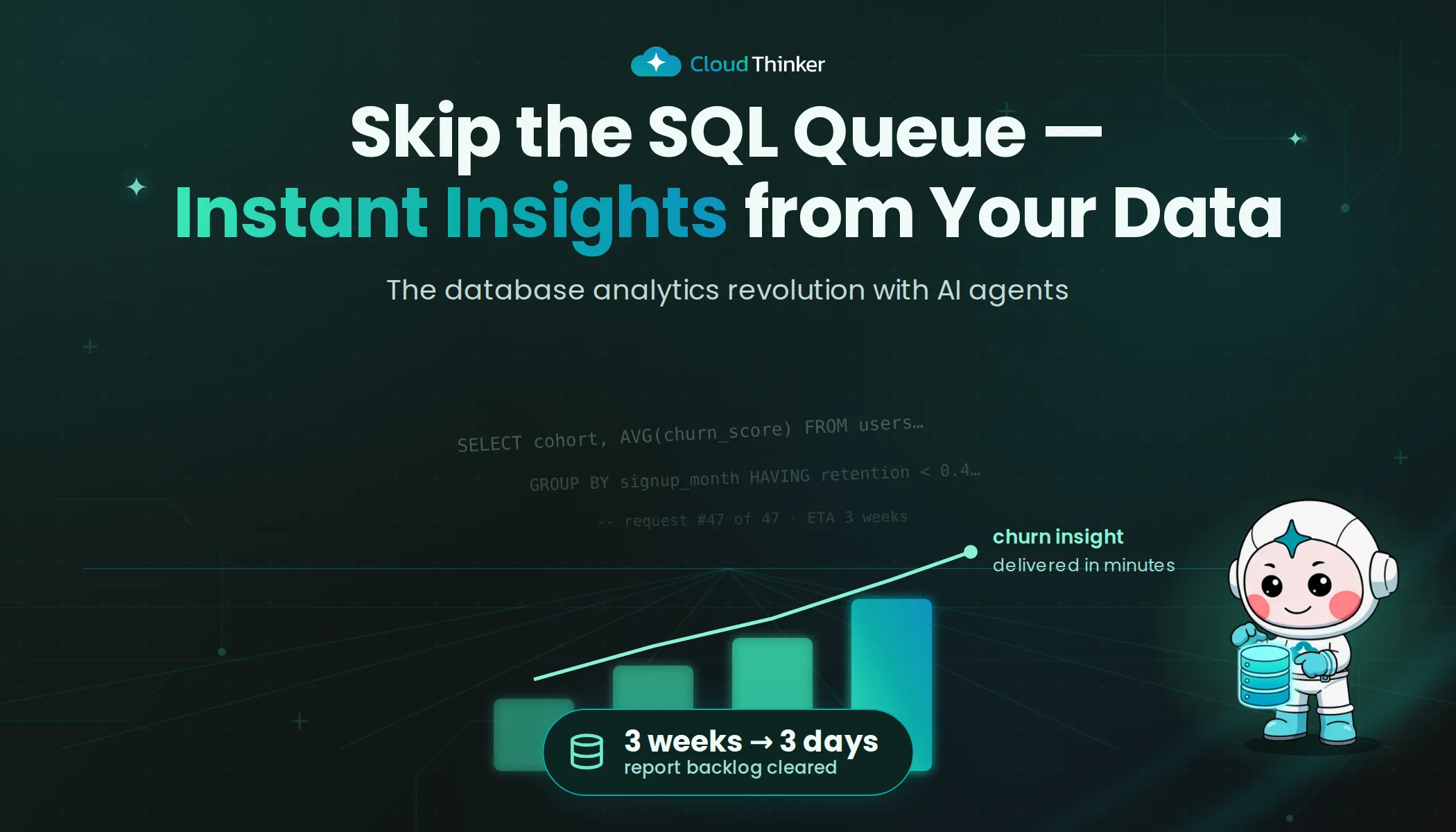
Forty-seven. That was the number of pending report requests in the queue on Monday morning.
Elena, the Head of Data at a B2B SaaS company we'll call Meridian, stared at the Jira board and felt the familiar weight of an impossible backlog. Each ticket was someone in the company who needed data to make a decision. Product wanted feature adoption metrics. Sales needed pipeline conversion analysis. Customer success was asking for health scores segmented by plan tier. Finance wanted a cohort retention breakdown for the board deck.
Average turnaround for a report request: three weeks. Not because the queries were complex, though some were, but because Elena's team of two analysts was the bottleneck every data question in the company had to pass through. They wrote the SQL, validated the results, built the visualizations and explained the caveats. Forty-seven requests, two analysts, three-week turnaround.
Then the CEO's request arrived.
The request that broke the queue
It came via Slack, flagged urgent: "I need a churn analysis by customer segment, correlated with product usage patterns over the past 12 months. Board meeting is Thursday."
Elena did the math. The analysis would need to join customer data from PostgreSQL with product usage events from the analytics warehouse, segment by plan tier, calculate churn per cohort, correlate with feature engagement, and produce charts fit for a board. Under normal circumstances, a two-day project for a senior analyst.
Both analysts were mid-sprint on the quarterly business review report. Pulling one off would delay the QBR, which the CFO had already asked about twice. Not pulling anyone off meant telling the CEO his board prep wouldn't be ready.
Elena opened a SQL editor, resigned to another late night, and started writing the first of what she estimated would be seventeen queries.
That's the everyday reality of database analytics: companies sitting on years of valuable data across PostgreSQL, MySQL and cloud databases, with most of it untouched, because every insight needs a person to translate a business question into SQL, check the output and format it for someone else.
Why the analyst queue never shrinks
Elena's team wasn't slow. The backlog had structural causes, and none of them was headcount:
Every question is bespoke SQL. "Churn by segment" sounds like one question. In practice it's a cohort definition, a churn definition, a join across two systems and a set of filters that only make sense if you know the schema. Each new question starts that work from scratch.
BI tools answer the questions someone predicted. Dashboards are excellent for the metrics you decided to track last quarter. The CEO's question wasn't on any dashboard, and most urgent questions aren't.
The caveats live in people's heads. Which customers are missing a plan tier, which week the event logger was down, which test accounts to exclude. An analyst carries that knowledge. A self-service tool doesn't, so self-service results get second-guessed and come back to the analysts anyway.
Data is split across databases. Customer records in the production PostgreSQL, usage events in the warehouse. Joining them means exports, staging tables or a pipeline someone has to build first.
More analysts raise the ceiling, not the slope. A third hire would shrink the backlog for a quarter, then request volume would grow to fill the new capacity. The constraint was that every data question needed a human translator between the business and the database.
How analytics got here
The move from manual queries to intelligent analytics follows a familiar arc:
01Stage one
Manual queries
SQL scripts, spreadsheet exports and static reports, one request at a time.
02Stage two
BI tools
Dashboards and scheduled reports for the questions someone predicted.
03Stage three
Advanced analytics
Models and real-time dashboards, built and maintained by specialists.
04Stage four
AI-driven analytics
A plain-English question becomes queries, checks and charts.
Elena's team was stuck between stages two and three. They had good databases, a decent BI tool and two talented analysts. What they lacked was a way to scale the translation step itself.
The churn question, end to end
When Elena connected CloudThinker to Meridian's databases, the first thing it did was map the schema: tables, relationships, data types and row counts across the PostgreSQL production database and the analytics warehouse. Within an hour it had a working picture of where the data lived and how it connected.
Then she gave it the CEO's request in plain English: "Analyze customer churn by segment, correlated with product usage patterns, over the past 12 months."
01Ask
Plain English
Churn by segment, correlated with usage, over 12 months.
02Map
Schema
Tables, relationships and row counts across both databases.
03Plan
Six queries
Cohorts by plan tier and signup month, joined to engagement.
04Check
Validate
Totals reconciled; missing plan tiers and an event gap flagged.
05Deliver
Four charts
Ready for an analyst to review and annotate.
1. Name the readings. A churn question has a few possible answers, and each needs different data. Churn could be concentrated in one plan tier, which shows up in a cohort table. It could track low feature engagement, which needs usage events joined to accounts. Or part of the apparent pattern could be a data artifact, which only shows up if you go looking for gaps.
2. Build the cohorts. The plan started with churn by plan tier and signup month, the backbone everything else hangs off. The shape of that query, with table names simplified:
WITH cohorts AS (
  SELECT c.id,
         c.plan_tier,
         date_trunc('month', c.created_at) AS signup_month,
         c.churned_at
  FROM customers c
  WHERE c.created_at >= now() - interval '12 months'
)
SELECT plan_tier,
       signup_month,
       count(*) AS customers,
       count(*) FILTER (WHERE churned_at IS NOT NULL) AS churned,
       round(100.0 * count(*) FILTER (WHERE churned_at IS NOT NULL) / count(*), 1) AS churn_pct
FROM cohorts
GROUP BY plan_tier, signup_month
ORDER BY plan_tier, signup_month;
Six queries in all ran across the two databases, with three intermediate transformations, feature engagement scoring, and a correlation between usage intensity and retention.
3. Check the data before trusting the answer. Before any chart, the results were reconciled against known totals, and two checks went looking for artifacts:
-- Customers that can't be segmented
SELECT count(*) FROM customers WHERE plan_tier IS NULL;

-- Days with no usage events at all
SELECT d::date AS day, count(e.id) AS events
FROM generate_series(now() - interval '12 months', now(), interval '1 day') AS d
LEFT JOIN usage_events e
  ON e.occurred_at >= d AND e.occurred_at < d + interval '1 day'
GROUP BY d
HAVING count(e.id) = 0
ORDER BY d;
Both found something: a batch of customers with no plan tier, and a gap in usage events from a logging outage in March. Either one, left unflagged, would have skewed the engagement correlation. Both were called out in the output, so the board deck didn't read low usage into a month where the logger was simply down.
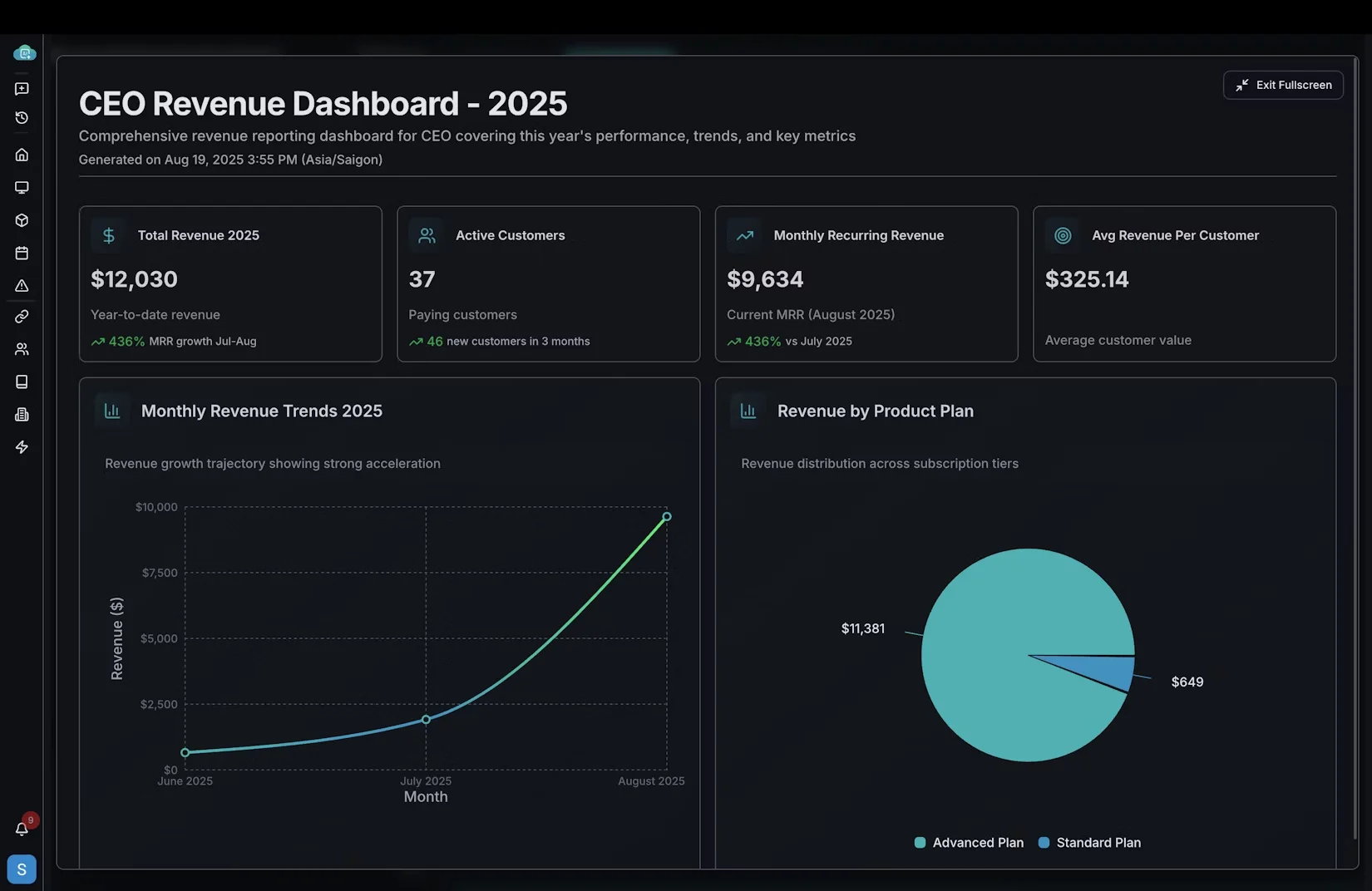
4. Deliver a draft, not a verdict. The output was four visualizations with the caveats attached. Time elapsed: 14 minutes.
Elena spent another 30 minutes reviewing it, adjusting one chart's axis labels and adding a narrative summary. The CEO had his board deck by Tuesday afternoon, two days early.
The backlog that disappeared
The churn analysis was one request. The real test was the rest of the queue.
Over the following two weeks, Elena triaged the backlog into three groups:
0128 tickets
Routine reports
Produced by CloudThinker, checked by an analyst before sending.
0213 tickets
Analytical drafts
A first analysis in minutes, refined by an analyst.
036 tickets
Human-led
Ambiguous or novel questions that needed judgment from the start.
The 28 routine reports were finished in three days, processed in parallel while the analysts focused on harder work: feature adoption metrics, pipeline conversions, usage summaries, the steady stream of "can you pull the numbers on X" that had consumed 60 percent of the analysts' time.
The 13 analytical questions took another week, and the workflow changed shape. Instead of an analyst spending a full day per request, CloudThinker produced an initial analysis in minutes. The analyst's role moved from query writer to reviewer: checking the approach, catching edge cases, adding the business context only someone inside the company has.
The 6 complex requests stayed human-led, as they should: strategic analysis, ambiguous stakeholder requirements, and analytical frameworks nobody had tried before.
By the end of week three, the backlog was at zero for the first time in Elena's tenure. New requests were turned around in hours instead of weeks.
Why this beats the traditional workflow
| Analyst queue with a BI tool | With CloudThinker | |
|---|---|---|
| A new question | A ticket, then a wait of up to three weeks | A plain-English request, a draft in minutes |
| Cross-database joins | Exports or a pipeline built first | Planned across both databases from the schema map |
| Data quality caveats | In the analyst's head, if they remember | Checked and flagged in the output |
| Routine reports | Consume most analyst time | Drafted automatically, reviewed by an analyst |
| Analyst time | Writing SQL | Reviewing, adding context, building new capability |
| Scaling | Hire, then watch demand fill the capacity | Throughput no longer tied to query-writing hours |
The deeper difference is where the analysts' judgment goes. In the old workflow, most of it was spent on translation: turning a question into joins and filters. With the translation handled, the same judgment goes into whether the answer is right and what it means, which is the part nobody else in the company can do.
Read-only by design
Analytics should never be the reason a production table changes. CloudThinker connects to your databases with a read-only user you create, ideally pointed at a replica, so every query is a SELECT and the database enforces that, not the agent.
Anything beyond reading, like a scheduled report going to stakeholders or a dashboard shared with another team, goes through Auto Mode, so you decide what runs on its own and what waits for approval.
The data team meeting that felt different
At the monthly team meeting, Elena shared a number that surprised even her. In the previous quarter, her team had completed 89 report requests. In the first month with CloudThinker, they'd completed 67. Not by working harder, but by removing the bottleneck that had been throttling throughput.
"We used to be a query factory," Elena told the team. "Every request came in, an analyst wrote SQL, validated it, visualized it, and moved to the next ticket. We were good at it. But we were a two-person factory with fifty-person demand."
The bigger change was what became possible. One analyst built a self-service analytics layer that let product managers explore feature adoption without filing a ticket. The other built a predictive churn model the customer success team now uses daily. Both had been on the "someday" list for over a year, and both shipped in the first month because the analysts finally had the time.
The forty-seven pending requests were a symptom of a team stuck in reactive mode, translating business questions into SQL instead of driving strategic insight. CloudThinker didn't replace Elena's analysts. It gave them back the time to do what analysts actually do: think.
Getting started
1. Create a read-only database user, scoped to the schemas you want analyzed, ideally on a read replica, and add it as a connection.
2. Ask your backlog's most common question.
"Map the schema of our production PostgreSQL database and the analytics warehouse, then show churn by plan tier and signup month for the last 12 months. Flag any data quality issues that could skew the result before you chart anything."
3. Hand it a recurring report.
"Every Monday, draft a pipeline conversion report by stage and segment from the CRM tables, and send it to me for review. Don't share it with anyone else until I approve it."
Related reading
- Auto Mode: you decide what runs on its own
- CloudThinker Connections: how CloudThinker reaches your stack
- The connection value ladder
- Building a multi-account FinOps dashboard on AWS
CloudThinker turns database analytics from manual queries into reviewed, explained insights across PostgreSQL, MySQL and cloud databases. Book a discovery call to try it against your own backlog.