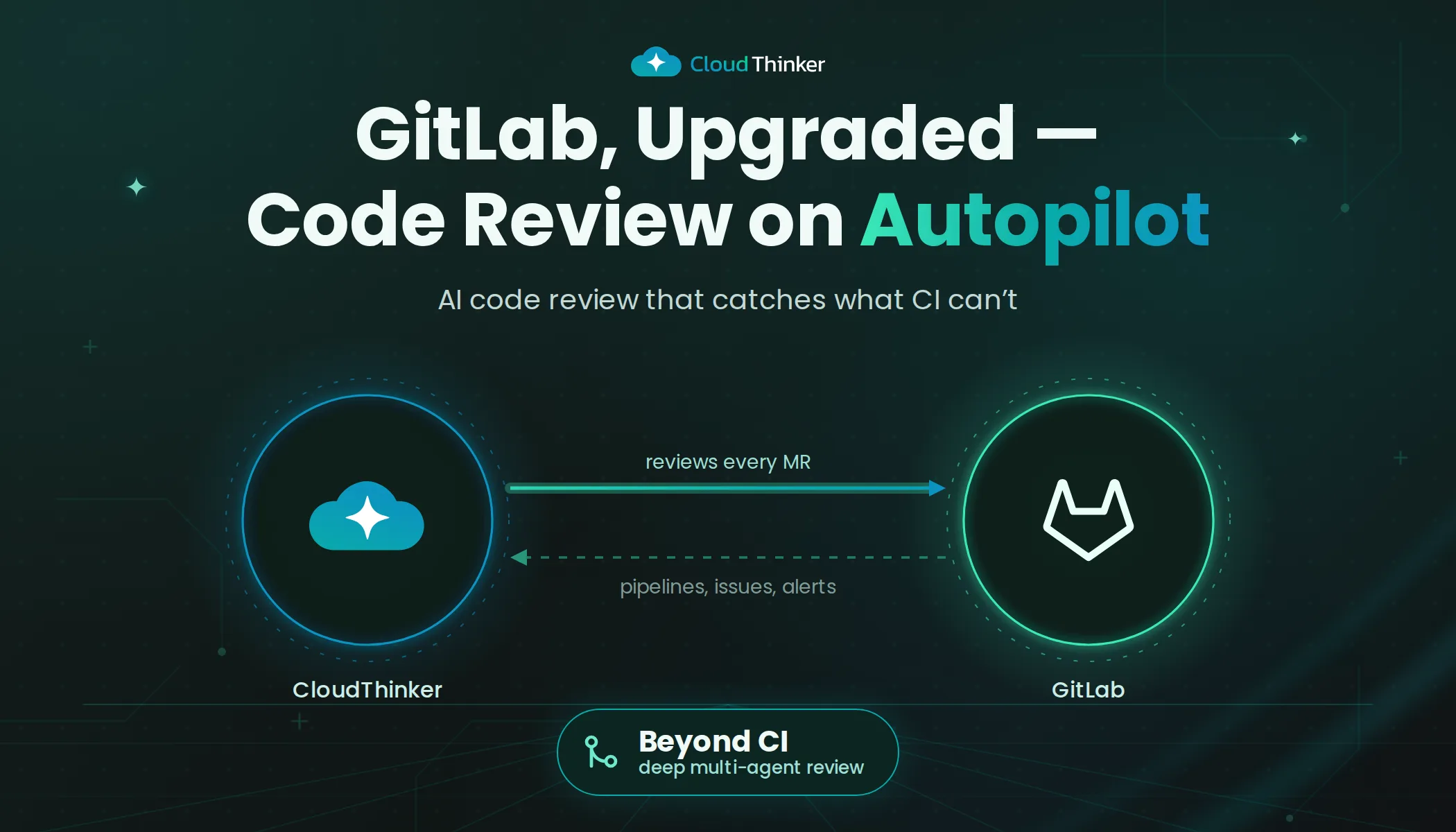
CloudThinker Makes GitLab Autonomous
How CloudThinker turns GitLab from a passive code repository into a delivery pipeline that reviews, diagnoses and learns on its own, inside limits you set.
It's 3:17 a.m. Your phone lights up. PagerDuty. Again.
A developer merged a merge request six hours ago: a harmless-looking refactor that passed all unit tests, got a quick "LGTM" from a tired reviewer and sailed through GitLab CI. Inside it were a missing leading slash in a URL path, a subtle security misconfiguration, and a database query that was fine in staging and falls over under production load.
Now the API is returning 500s. The on-call SRE is half-asleep, scrolling through 200 lines of pipeline logs trying to work out what changed. The incident channel fills up with "is anyone looking at this?" and the MTTR clock is running.
That night happens on most teams that run GitLab, and it's why we built CloudThinker's GitLab integration. We didn't want another dashboard or another notification. We wanted GitLab to do some of the thinking.
What "autonomous GitLab" means
The word "autonomous" gets used loosely in AI, so here's the precise version.
GitLab, by design, is a passive platform. It stores your code, runs pipelines when triggered and shows the results. If you configure a CI rule, it enforces it. If you don't, it doesn't. It's powerful, and it waits for humans to review, decide and intervene.
CloudThinker makes GitLab an active participant in delivery. It adds five capabilities GitLab wasn't designed to have:
1. Perception. CloudThinker reads more than the diff. It understands what the merge request relates to, which incidents similar patterns have caused before, what the infrastructure looks like downstream, and what the author's historical quality patterns show.
2. Reasoning. It doesn't apply static rules. It reasons about code the way a senior engineer would: "This endpoint handles authentication tokens, the error handling is incomplete, and the last time similar code shipped, it caused incident #4523." Underneath is a multi-model backbone, including Anthropic's Claude (Haiku, Sonnet, Opus) and Zhipu's GLM (4.7 Flash, GLM 5), with different models routed to different tasks by complexity, latency and cost.
3. Decision-making. Different changes carry different risk, and the review matches it. UI tweaks, copy changes and test additions need light automated checks. New features and business logic get an AI pre-review plus human approval. Security code, infrastructure changes and data migrations get multiple reviewers plus security sign-off. What CloudThinker is allowed to do on its own at each level is set by Auto Mode, covered below.
4. Action. It does more than comment. It can block merges, suggest specific code fixes, trigger targeted pipeline stages, escalate to the right person and, most usefully, tie post-deployment anomalies back to the exact merge request that caused them.
5. Learning. Every review, incident and resolution feeds CloudThinker's Knowledge Graph. That builds an institutional memory that survives team turnover.
The result isn't GitLab with an AI plugin bolted on. It's GitLab with a nervous system.
Why now: vibe coding needs guardrails
AI coding assistants changed the volume of code that reaches review. The quality didn't keep up.
The numbers
The SUSVIBES benchmark is a sobering read on agent-generated code:
- 47.5% of AI-generated code is functionally correct
- 8.25% passes security review
- 66% productivity tax from fixing AI-generated technical debt
- 10x faster code generation means 10x faster risk accumulation
Less than half of AI-generated code works correctly. Less than one in ten passes security review. And teams are shipping it faster than ever. Palo Alto Unit 42 has identified AI-generated code as a top attack vector, a present risk rather than a future one.
Why traditional review breaks
Human review (read the diff, leave comments, wait for a response, repeat) was designed for developers writing maybe 200 lines a day. With Copilot or Cursor, one developer can produce thousands of lines in an afternoon. The arithmetic stops working:
- A thorough review takes 60 to 90 minutes for a substantial merge request
- The average enterprise team now produces 3 to 5x more MRs per day than two years ago
- Senior engineers, the ones best equipped to catch subtle issues, are the scarcest resource
- Review quality drops as volume rises: the "LGTM" problem
Each automated layer covers one slice and misses the same thing.
01CI/CD
Tests pass
Catches syntax errors and failing tests. Says nothing about tests nobody wrote.
02Static analysis
Known patterns
Finds vulnerability signatures it has rules for, one file at a time.
03Human review
LGTM at volume
Thorough on the first MR of the day, a skim by the twentieth.
04The gap
Context
Architecture, incident history and compliance, the things that make correct code wrong.
GitLab CI/CD catches syntax errors and test failures. Static analysis catches known vulnerability patterns. Neither catches the contextual issues, the ones that need an understanding of the system's architecture, its incident history and its compliance requirements, and of the ways "correct" code can still be wrong.
Between "code works" and "safe to deploy"
Vibe-coding tools help developers write code locally. CloudThinker makes sure what moves forward is safe and compliant for the production environment. The checkpoint is the one GitLab hosts but doesn't actively manage:
Development -> Change Request -> [CODE REVIEW] -> Senior Approval -> Deploy
That code review stage, between a developer's IDE and production, is where CloudThinker sits. It's the last line of defense, so it needs to be context-aware and it can't get tired.
How it works
01Source and CI
 GitLab
- Merge request eventsOpened, updated, commented
- Pipeline eventsCompleted or failed, with logs
- RepositoryDiff, history, surrounding code
- MR discussionsInline comments, summary, approval status
No Runner changes
02Review and reasoning
 CloudThinker
- RoutePick the review skills for this MR
- Build contextMemory, Knowledge Graph, docs
- ReviewQuality, security, infra, operations
- LearnFindings and outcomes written back
Runs in an isolated sandbox
03Where the team works
Same places
- The merge requestSeverity-ranked findings with fixes
 Slack or TeamsPipeline RCA and approvals
 On-callIncidents linked to the MR that caused them
- JiraFollow-ups with evidence
No new dashboard
The architecture is a 10-layer platform stack, a 14-stage execution pipeline, a set of specialized review skills, and a closed loop that connects code review to incidents, infrastructure and knowledge. Here's a merge request's path through it.
The GitLab connection
CloudThinker uses GitLab's native webhooks and API. When a developer opens a merge request, GitLab fires a webhook event that CloudThinker's Integration Layer (L7) receives through MCP (Model Context Protocol) connectors. A merge request hook payload carries everything needed to start (trimmed):
{
  "object_kind": "merge_request",
  "event_type": "merge_request",
  "project": { "id": 482, "path_with_namespace": "acme/accounts-web" },
  "object_attributes": {
    "iid": 1197,
    "action": "open",
    "source_branch": "refactor/account-nav",
    "target_branch": "main",
    "last_commit": { "id": "9f3c2e1" }
  }
}
The integration works both ways:
- Inbound: MR opened, updated, pipeline completed, comment added
- Outbound: review comments posted, approval status updated, pipeline stages triggered, merge blocked or approved
There are no GitLab Runner changes and no custom CI scripts. CloudThinker works as a middleware layer that adds to GitLab's native capabilities without replacing them.
Routing: deciding what this MR needs
The event reaches the Agent Router (L2 in the stack), which classifies intent and selects skills:
- Is this a code change that needs review? Run the Code Review skill.
- Does it touch infrastructure configuration? Add the Security Audit skill.
- Is it in a service that had a recent incident? Pull that incident's context from the Knowledge Graph.
- Does the author have a history of specific quality patterns? Adjust the review depth.
Routing is automatic. Nobody has to @mention anything.
Context building: what the model sees first
This is where CloudThinker differs most from other code review tools. Before a model reads a single line of the diff, the Intelligence Core (L3) assembles the context:
- Working memory: the current diff, commit messages, branch metadata, pipeline status and any inline discussion.
- Episodic memory: past reviews of the same codebase, previous feedback patterns for this author, historical quality scores for the repository.
- Knowledge Graph: the connected graph of assets, incidents, changes and team knowledge. If a similar pattern caused an outage three months ago, the graph knows and surfaces it.
- RAG pipeline: relevant documentation, runbooks, architectural decision records and compliance requirements, retrieved into the review context.
The LLM routing layer then picks a model per sub-task: Claude Opus for complex architectural reasoning, Claude Sonnet for full code analysis, Claude Haiku for fast triage and classification, GLM 4.7 Flash for low-latency intent detection, and GLM 5 for advanced reasoning. It balances accuracy, speed and cost on each call.
This context stage is what makes incident-aware review possible: cross-referencing a merge request with incident history so known failure patterns don't ship twice.
The 14-stage execution pipeline
Every review request runs through the same 14 stages:
- Intent detection: classify the MR event and the skills it needs
- Guard-in: safety checks for PII, injection and schema validity
- Skill selection: choose the review skills (Code Review, Security Audit and so on)
- Context building: assemble working memory, episodic memory and Knowledge Graph context
- LLM routing: pick the model for each sub-task (Claude Opus, Sonnet or Haiku, GLM 4.7 Flash or GLM 5)
- Sandbox boot: start CloudThinker's Sandbox for safe code analysis
- Pre-hook: apply team-specific review configuration and quality thresholds
- Tool execution: run the analysis itself, including AST parsing, dependency checks and pattern matching
- Chain: if the review finds infrastructure concerns, hand off to the Cloud Ops or Security skill
- Guard-out: check that review comments are constructive, actionable and correctly formatted
- Event log: record the full review trace for audit
- Evaluation and tracing: an LLM-as-judge scores the quality of the review itself
- Memory write: update the Knowledge Graph with new patterns, findings and author feedback
- Deliver: post the review to GitLab as inline comments, a summary and an approval or blocking decision
Every stage is logged, traceable and auditable, which enterprise environments need, especially regulated ones like banking.
The review: one supervisor, several specialists
A merge request doesn't go to one generic reviewer. A supervisor reads the intent, assesses the scope and risk, and dispatches specialist reviews for each dimension of the change. An MR that touches API routes, database queries and Kubernetes manifests gets a code quality review, a security review, an infrastructure review and an operational readiness review, and the supervisor merges them into one.
The developer sees one review, not four bots commenting separately. The supervisor resolves conflicting recommendations, ranks findings by actual risk and gives a clear verdict. The review covers:
- Performance. N+1 queries, unoptimized loops, missing indexes, memory leaks and concurrency issues, found by reasoning about execution paths rather than static pattern matching.
- Security. Vulnerability detection aligned with compliance standards. For banking clients, that means alignment with regulations like Vietnam's Circular 09. It catches SQL injection, XSS, insecure deserialization, broken authentication and sensitive data exposure.
- Correctness. Beyond "does it compile": does the code do what the commit message says? Are edge cases handled and error paths complete?
- Architecture. Does the MR introduce coupling that crosses the project's boundaries? Does it follow established patterns, or introduce new ones without documentation? Will it change infrastructure topology downstream?
- Operational readiness. Is the change observable, with enough logs and metrics? How will it behave under production load? What's the blast radius if it fails?
- Severity classification. The supervisor deduplicates overlapping findings and classifies each one as Critical, High, Medium or Low, with a specific remediation. Not "fix this" but "here's the corrected code."
On our benchmark of 37 real-world bugs, this approach reached an 81% bug detection rate, ahead of Greptile (78%), Cursor (54%), Copilot (48%), CodeRabbit (46%) and Graphite (8%). The benchmark write-up has the method.

The LeaderBoard: making quality visible
CloudThinker also tracks quality over time with a LeaderBoard. Each developer gets a quality score on a 1 to 10 scale that balances code quality with productivity, based on:
- The severity distribution of findings across their MRs
- How they respond to review feedback
- The trend over time, improving or declining
- Consistency across different types of change
Developers see their scores rise as they absorb the recommendations. Engineering managers see team-wide quality trends without micromanaging individual reviews.
Pipeline failure root cause analysis
When a GitLab CI/CD pipeline fails, most teams start the same loop: read the logs, trace the error, find the cause, fix it, push again. CloudThinker takes the first half of that loop:
- The pipeline failure event arrives through the GitLab webhook
- CloudThinker reads the full job log, not just the last error line
- It checks the Knowledge Graph: has this failure pattern happened before, and what fixed it?
- It correlates the failure with recent merge requests, infrastructure changes and dependency updates
- It posts a root cause analysis on the MR, with a suggested fix
Starting from the possible readings matters here. A red pipeline is usually one of four things: the change itself broke a test, a dependency moved underneath it, the runner or environment is unhealthy, or the test is flaky. They predict different evidence. A real break fails the same way on retry and only on this branch. A dependency drift shows up as a version change in the lockfile or a new image digest. A runner problem fails across unrelated projects at the same time. A flaky test has passed and failed on the same commit before. CloudThinker checks each against the job log and history, and only then names a cause. Reading the job log is a plain API call:
curl --header "PRIVATE-TOKEN: $GITLAB_TOKEN" \
  "https://gitlab.example.com/api/v4/projects/482/jobs/90311/trace"
GitLab CI goes from "your build failed, figure it out" to "your build failed because of X, here's the fix, and here's the MR that introduced it."
The closed loop: from review to incident prevention
The most valuable part of the integration isn't any single feature. It's the loop that connects them.
01Prevent
Review
Catch the bug in the merge request, before it becomes an incident.
02Monitor
Watch the deploy
Tie a CPU spike or error-rate jump to the MR that shipped it.
03Diagnose
Root cause
Correlate alerts with commits and infra events to name the change.
04Learn
Knowledge Graph
The resolution shapes the next review of a similar pattern.
Prevent. Code is reviewed before deploy, so bugs are caught before they become incidents, with scrutiny matched to each change's risk.
Monitor. After deploy, infrastructure health is watched for anomalies from the new code. If a deploy causes a CPU spike, a memory leak or a jump in error rate, it's correlated with the specific MR.
Detect and diagnose. When an incident happens, alerts are correlated with code changes and infrastructure events for fast root cause analysis. The answer names which commit caused it.
Resolve and learn. Every resolution feeds the Knowledge Graph. The next time a similar pattern shows up in a merge request, the review knows: "A pattern like this caused incident #4523 three months ago. Block and escalate."
That loop is what makes GitLab autonomous. It works less like a point solution and more like an immune system: each infection teaches it to stop the next one.
One merge request, end to end
Here's a real review, the kind that happens dozens of times a day in any organization running GitLab.
10:14 a.m. A developer opens a merge request that refactors the account settings page, consolidating five separate pages into one view with tab-based navigation. 27 files changed. The title: "refactor(routes): update return URLs and action links to consolidate account navigation."
10:14 a.m., seconds later. CloudThinker receives the webhook. The router classifies it as medium risk: a UI refactor with route changes. Context building pulls the repository's architectural patterns, the author's review history and any incidents related to routing changes.
The review starts from what a route consolidation can break. Links that still point at the old pages. Permission checks that lived on the old routes and didn't move. Return URLs that resolve relative to the new location instead of the root. Query parameters the new tabs parse differently. Each one is a specific thing to check across the 27 files.
10:15 a.m. The review is posted to GitLab as inline comments:
- Review score: 8/10
- Review coverage: 27 files analyzed
- Findings: 0 critical, 0 high, 1 medium, 1 low
- Security: OK. No security issues, permission checks in place, no injection risks
- Performance: OK. Clean refactor with no regressions
- Navigation consolidation: OK. Settings cleanly merged into one account page
The medium finding is exactly the third reading above: a missing leading slash in a URL path. action_url in quota_monitoring_service.py uses a relative path instead of an absolute one. The low finding is the fourth: a parsing function in referrals-tab-content.tsx can return NaN for invalid URL parameters.
Verdict: CONCERNS. One medium issue should be fixed before merge.
10:16 a.m. The developer fixes both. CloudThinker re-reviews and approves. Total elapsed time: 2 minutes. Human review time saved: roughly 45 to 60 minutes.
10:17 a.m. The LeaderBoard updates. The author's score reflects a clean refactor and a quick fix.
A missing slash is the same kind of bug as the one behind the 3:17 a.m. page at the top of this post. This time it surfaced as a review comment, not a page.
Why this beats the traditional workflow
| Traditional GitLab workflow | With CloudThinker | |
|---|---|---|
| First review | When a reviewer is free, often hours later | Within minutes of the MR opening |
| Context | What the reviewer remembers | Incident history, architecture, docs and past reviews |
| Coverage | Whoever reviews, whatever they know | Performance, security, correctness, architecture, operations |
| Pipeline failures | Read the log, guess, push again | Root cause and fix posted on the MR |
| Post-deploy incidents | Traced back to a commit by hand | Correlated with the MR that shipped it |
| Knowledge | Leaves when people do | Kept in the Knowledge Graph and reused |
The deeper difference is that the traditional workflow treats review, CI and incident response as separate steps owned by separate people. CloudThinker treats them as one loop, so what's learned at 3 a.m. shows up in the next morning's review.
Auto Mode: trust earned, not assumed
A common objection is "I don't trust AI to make merge decisions." That's reasonable. CloudThinker reads freely (diffs, pipelines, history) and posts its review and recommendation with reasoning, and every action it takes in GitLab, from approving a merge to blocking one to triggering a pipeline stage, goes through Auto Mode. You decide what runs on its own and what waits for approval, so your security-critical banking middleware can keep a person on every merge.
The infrastructure: enterprise-grade execution
CloudThinker doesn't run code analysis on a shared server. Every review runs in an isolated, ephemeral sandbox inside a three-tier isolation model:
Organization (tenant boundary). Each customer runs in a fully isolated Organization with SSO/SAML, RBAC policies, billing, audit logs and user management. No data crosses Organization boundaries.
Workspace (project or team isolation). Inside an Organization, teams create Workspaces to separate their work. Each Workspace has its own knowledge base, skill configuration, permissions and connection credentials.
Sandbox (ephemeral execution). Every operation runs in CloudThinker's ephemeral Sandbox. Sandboxes are created on demand, run the task and are destroyed immediately. No data persists, and no sandbox can reach another.
For enterprise deployments, CloudThinker integrates into existing cloud Landing Zones through VPC Peering or PrivateLink, with no public internet exposure. The Knowledge Graph runs on Neptune or Cosmos with a RAG engine. All communication goes through PrivateLink with zero public endpoints. The Connections post covers the network options in detail.
The security posture: AES-256 encryption at rest, TLS 1.3 in transit, BYOK (Bring Your Own Key) so customers control their AI model keys, SOC 2 Type II certification, and built-in compliance templates for regulated industries.
The bigger picture: from AIOps to VibeOps
The GitLab integration is one part of a larger direction we call VibeOps: the move from traditional AIOps (dashboards and recommendations) to operations that act and improve themselves.
VibeOps runs on one principle: Perceive, Correlate, Hypothesize, Act, Learn, Improve. Code review is the Perceive and Hypothesize stage. Incident response is Correlate and Act. The Knowledge Graph is Learn and Improve. GitLab is the connective tissue between them.
When we say CloudThinker makes GitLab autonomous, we don't mean GitLab runs without humans. We mean it runs with intelligence: it sees context people miss, reasons over months of history, decides with calibrated confidence, acts inside the limits you've approved, and learns from every outcome.
The 3 a.m. pages don't have to be inevitable. The code that causes them can be caught before it merges, and the fix for each one can be kept and reused.
Getting started
1. Connect GitLab. CloudThinker integrates in minutes, with no Runner changes and no workflow changes. The setup guide has the steps.
2. Open a merge request. The review arrives on the MR automatically. Nothing changes state until you approve it.
3. Ask about your pipelines from chat.
"Look at the last 20 failed pipelines on main in acme/accounts-web. Group them by root cause, tell me which ones were flaky tests, and propose a fix for the most common real failure. Propose only, change nothing."
4. Let one narrow class run on its own once you trust the reviews.
"For the docs-site repository only, approve merge requests that change nothing but Markdown files once the pipeline is green. Everything else still comes to a reviewer."
Start your free trial or book a demo to see the review on your own repositories.
Related reading
- What takes your team days, AI does in minutes: the code review benchmark
- CloudThinker AI code review for Azure DevOps
- Inside the FPT Cloud evaluation of CloudThinker AI code review
- Auto Mode: decide what runs on its own
Sources and references
- SUSVIBES Benchmark: "Is Vibe Coding Safe? Benchmarking Vulnerability of Agent-Generated Code"
- CloudThinker Review: independent benchmark of 6 AI code review tools across 37 real-world bugs
- Palo Alto Unit 42: AI-generated code identified as a top attack vector
- Greptile Benchmark Methodology: production codebase testing framework
- Gartner: "Predicts 2026: AI Potential and Risks Emerge in Software Engineering Technologies" (Dec 2025)