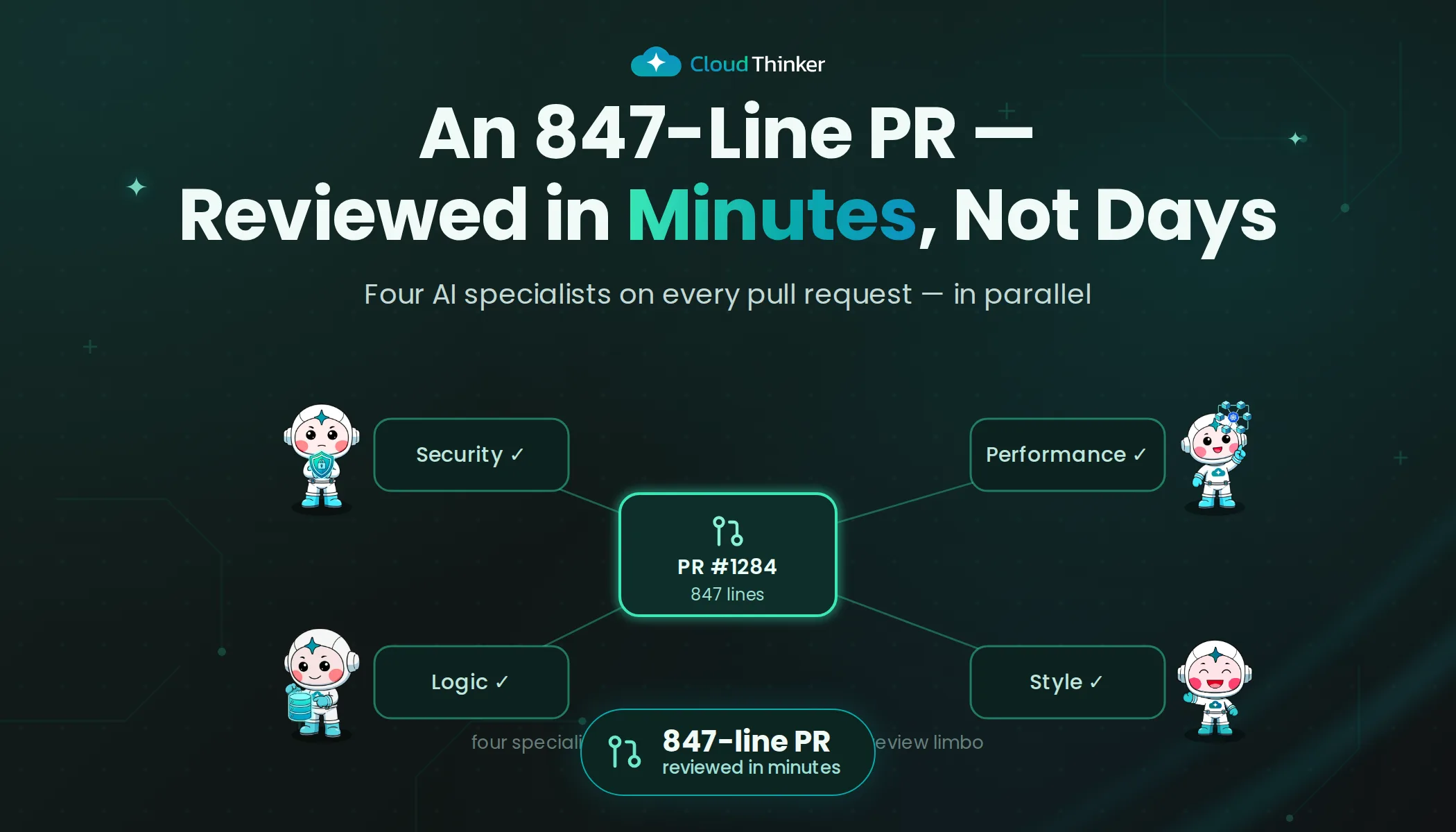
What Takes Your Team Days, AI Does in Minutes
Day three. Priya's 847-line pull request sat in review limbo.
It was not a neglected PR from a junior developer. It was a critical authentication refactor, the kind of change that touches session management, token validation, and database queries across fourteen files. The kind of change that needs eyes from security, performance, architecture, and senior engineering before it can ship.
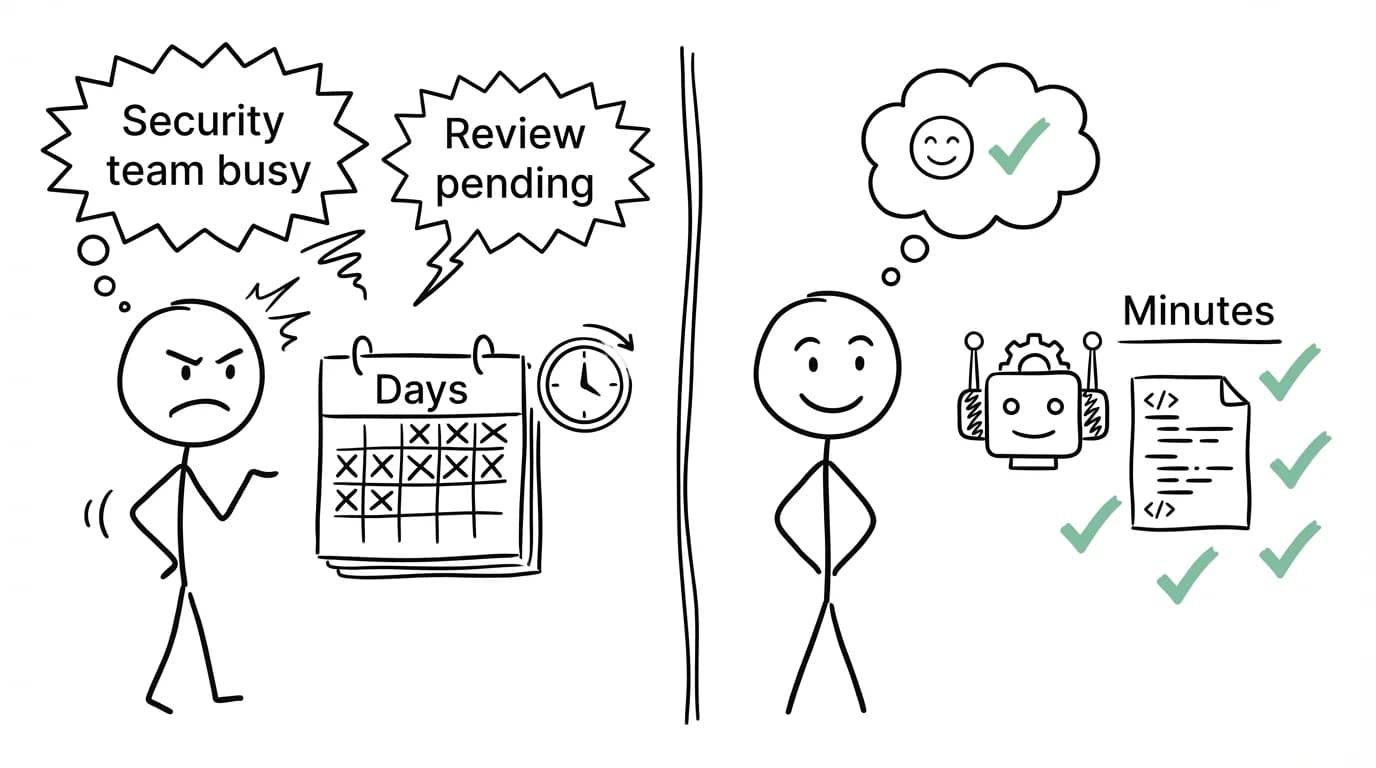
The problem was not that nobody wanted to review it. The problem was that the right people were all unavailable at the same time.
The security specialist, Raj, was on PTO until Thursday. The performance engineer, Marcus, was deep in a production optimization sprint for another team. The tech lead, Anna, had been in back-to-back meetings since Monday. And the senior developer who understood the auth codebase best had transferred to a different project two weeks ago.
So the PR sat. And on Friday, under pressure to hit a sprint commitment, the team merged it with a single approval from a developer who admitted he had only reviewed the test files.
The bug shipped on Tuesday. A race condition in the token refresh logic caused intermittent session drops for approximately 3 percent of users. It took two days to diagnose, a hotfix to resolve, and a post-mortem meeting where everyone agreed the root cause was not the bug itself, but the review process that missed it.
CloudThinker AI code review showing four specialized agents analyzing code in parallel: security, performance, logic, and architecture
The Hidden Cost of Comprehensive Review
Priya's team is not unique. The bottleneck they experienced is structural, built into the way code review works at most organizations:
- Scheduling dependencies. Getting four busy experts to review one change requires aligning calendars that never align. Your security expert checks for vulnerabilities, but she is booked until Thursday. Your performance engineer finds slow code, but he is reviewing another team's work.
- Context loading. Each reviewer spends 20 to 30 minutes understanding the change before they can evaluate it. For an 847-line PR touching fourteen files, that context-loading cost is significant, and every reviewer pays it independently.
- Sequential bottlenecks. In practice, reviews happen one at a time. The architecture review waits for the security review, which waits for the performance review. Each handoff adds a day.
- Attention decay. A review requested on Monday morning gets careful attention. The same review, finally looked at on Friday afternoon, gets a skim. Human attention is finite, and the review queue does not respect that.
Every day a PR sits blocked is a day of progress lost. Every perspective that gets skipped, because the expert is unavailable or the team is under deadline pressure, is risk shipped to production.
Four AI Specialists Working in Parallel
What if you could have four expert reviewers analyze your code simultaneously, in minutes instead of days?
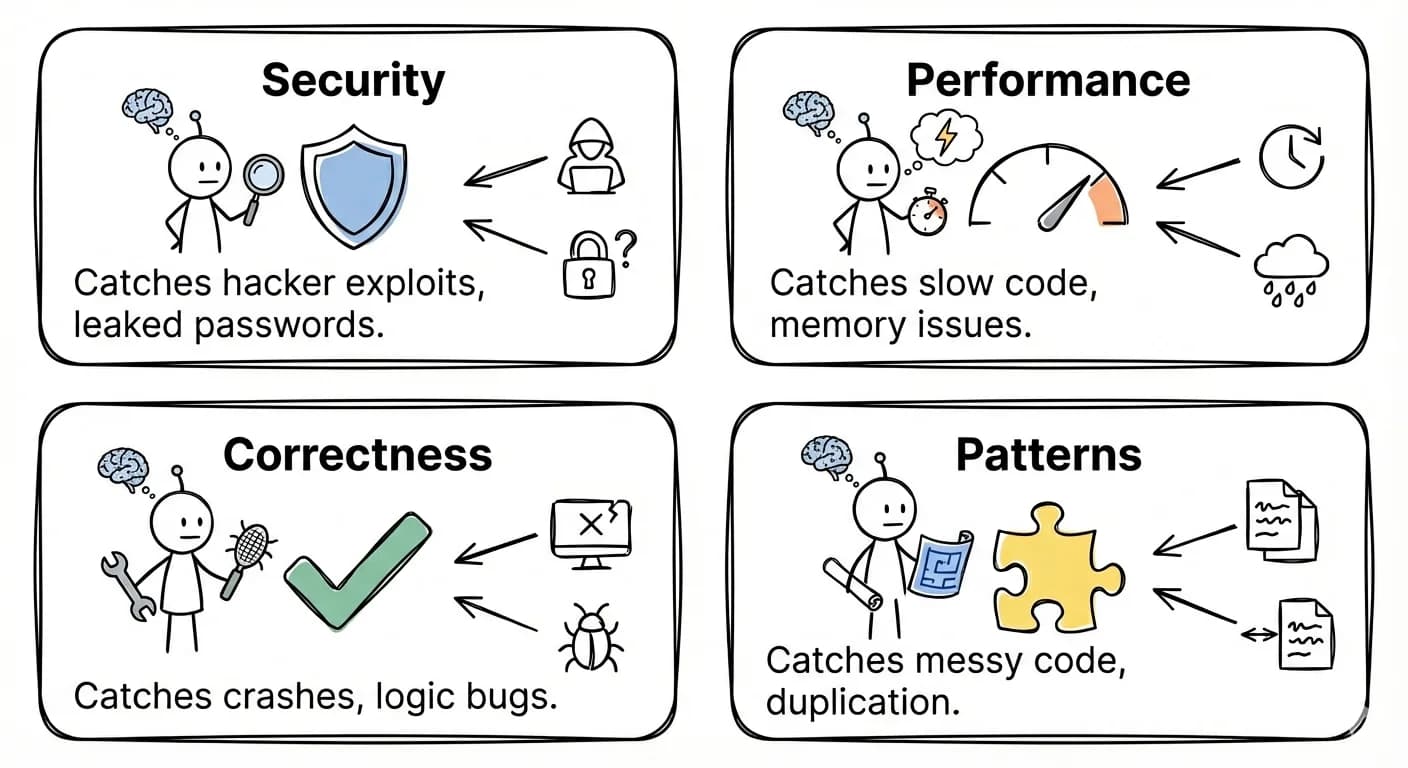
CloudThinker deploys four specialized AI agents in parallel, each focused on one domain. A security agent examines authentication flows, input validation, and vulnerability patterns. A performance agent profiles query complexity, memory allocation, and algorithmic efficiency. A logic agent traces control flow, edge cases, and race conditions, the exact category of bug that shipped in Priya's PR. An architecture agent evaluates design patterns, coupling, and maintainability.
The math is straightforward:
- Human review: 4 experts multiplied by 2-3 days of coordination equals days of waiting
- AI review: 4 specialists multiplied by parallel execution equals minutes
No scheduling conflicts. No context switching. No waiting for the security team to come back from PTO. Four deep analyses running simultaneously, in the time it takes to grab coffee.
Benchmark results comparing CloudThinker's 81% bug detection rate against Greptile (78%), Cursor (54%), Copilot (48%), CodeRabbit (46%), and Graphite (8%)
The Proof: Independent Benchmark
Claims about AI code review are easy to make. We wanted numbers. We tested 6 AI code review tools on 37 real-world bugs from production codebases, following Greptile's benchmark methodology.
| Tool | Detection Rate |
|---|---|
| CloudThinker | 81% |
| Greptile | 78% |
| Cursor | 54% |
| CodeRabbit | 46% |
| Copilot | 48% |
| Graphite | 8% |
These were not synthetic test cases. Each bug was a real defect that shipped to production in one of four major open-source projects: Cal.com (TypeScript), Sentry (Python), Grafana (Go), and Keycloak (Java). We excluded trivial issues and cases where fixes were ambiguous, ensuring every test case had a clear, verified solution.
A bug counts as "caught" only when the tool identifies the faulty line and explains the impact. All tools ran with default settings and full repository context.
An 81 percent detection rate means that out of 37 bugs that human reviewers missed, CloudThinker's parallel agents caught 30 of them. Including the kind of race condition that cost Priya's team a week of debugging and a post-mortem.
Works With Your Workflow
- GitLab and GitHub integration in minutes
- Automatic review triggered on every pull request
- Comments posted directly on the relevant code lines with priority levels
No new tools to learn. No workflow changes to negotiate with the team. The review happens automatically, and the results appear where developers are already looking.
What Changed for Priya's Team
Six weeks after adopting CloudThinker, Priya submitted another large PR. This one was 923 lines across twelve files, a payment processing integration with security implications.
Within seven minutes, she had four review reports. The security agent flagged a missing rate limit on the payment confirmation endpoint. The performance agent identified a database query inside a loop that would cause N+1 problems at scale. The logic agent caught an edge case where a timeout during payment processing could leave a transaction in an ambiguous state. The architecture agent suggested extracting the retry logic into a shared service.
Priya fixed all four issues before any human reviewer opened the PR. When the tech lead reviewed it the next morning, her comment was: "This is the cleanest payment integration PR I've reviewed this quarter."
No three-day wait. No scheduling conflicts. No bugs shipped to production. No post-mortem.
Four perspectives. Minutes, not days. Every code change.